In modern high-precision printing, coating, and finishing processes, the irreplaceability of wool paper rollers (commonly referred to in the industry as pulp rollers or elastic soft rollers) is determined by their unique microphysical structure, thermodynamic stability, and rheological behavior.
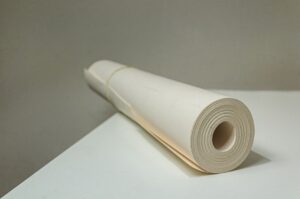
When operating under demanding conditions such as high-precision coated paper finishing, cigarette packaging aluminum foil embossing, and anti-counterfeiting printing, this solution represents the only viable choice for ensuring “no roller bursting, no paper damage, and high gloss.” Its irreplaceable professional mechanism can be broken down into the following four core dimensions:
I. Unique rheological behavior: the “microscopic shear polishing effect” within the nip zone
The high gloss and smoothness of printing materials (such as high-grade coated paper and opaque cardstock) cannot be achieved through simple “dead pressing”; instead, “ironing” is required. The wool paper roller serves as an ideal “ironing plate” during the finishing process.
- Nip width deformation and contact arc length: When the wool paper roller is pressed against a heated steel roller (hard roller), the elastic modulus of the paper roller surface allows for moderate local macro-deformation. This increases the nip width and extends the dwell time of the paper within the nip zone.
- Micro-slip and frictional shear force: Within the pressing zone, due to a slight discrepancy in the linear velocities of the soft and hard rollers within the geometric deformation region, a minimal amount of shear slip occurs between the surface of the wool paper roller and the surface of the paper. This slip generates a high-frequency “micro-polishing” effect.
- Irreplaceability comparison:
- Metal rollers (steel-to-steel): There is no slippage; these rollers only crush the high points on the paper surface (crush), resulting in uneven lateral thickness of the paper (caliper variation) and an increased likelihood of “metallic glare.”
- Polymer polyurethane/rubber rollers: Although they possess elasticity, if their surface coefficient of friction (COF) is either too high or too low, it can easily lead to paper tearing or the formation of slip marks, preventing them from achieving the extremely uniform and fine mirror-like finish characteristic of wool paper rollers.
II. Unique “Physical Tolerance”: exceptional resistance to carburation and superior heat dissipation capabilities under high shear conditions
In modern high-speed calendering machines (with line speeds typically ranging from 1,000 m/min to 1,500 m/min and pressures ranging from 300 N/mm² to 450 N/mm²), the internal hysteresis heat and surface friction heat generated within the calendering zone are particularly detrimental.
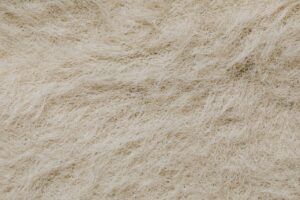
- The heat dissipation mechanism of porous fiber matrices: The wool paper roller is a non-woven matrix composed of up to 40% natural wool fibers interwoven with specialized plant fibers. Wool fibers naturally possess a hollow structure (medullary layer), which provides excellent capillary heat dissipation and respiratory effects.
- Dynamic viscoelastic thermal stability: Under high-frequency dynamic compression-release cycles, the wool paper roller exhibits an extremely low loss factor ($\tan \delta$). It can withstand continuous linear surface temperatures ranging from 150°C to 200°C without experiencing thermal softening or thermal creep.
- Irreplaceability comparison:
- Synthetic rubber or polymer soft rollers (such as polyurethane): Under high-speed and high-pressure conditions, the internal dissipation heat cannot be discharged promptly, making it highly prone to “thermal accumulation.” Once the glass transition temperature ($T_g$) is reached, the polymer chain segments slide, causing the roller body to melt instantaneously, leading to a “blow-out” event and resulting in severe production accidents.
- Standard cotton-based paper rollers: their maximum temperature resistance is typically below 130°C, making them highly susceptible to scorching and bowing carbonization under high-speed operating conditions.
III. Outstanding “Shape Deformation Memory” and “Foreign Body Tolerance”: Zero-Death Pit Effect
The printing workshop cannot completely avoid raw material defects. When paper splices, localized creases, or hard foreign objects (such as detached coating particles) pass through the press zone at high speeds, they can cause catastrophic damage to the rollers.
- The natural curly “micro-spring” network: wool fibers possess a highly developed micro-scale scale structure and inherent crimp. This network endows the paper roller with exceptionally high and rapid elastic recovery.
- Stress self-dissipation and “inclusion”: when an foreign object passes through, the protrusion rapidly embeds itself into the surface of the wool-paper roller. The paper roller absorbs energy through localized micro-deformation (where stress concentration is dispersed throughout the surrounding fiber matrix), thereby protecting the opposing hard roller from scratching while ensuring that the paper is not cut.
- Irreplaceability comparison:
- Cotton paper roller: The fibers exhibit high stiffness and poor elastic recovery; when foreign objects pass through, permanent “denting” marks will remain on the surface. During subsequent operation, these denting marks can cause periodic white spots to appear at corresponding positions on the printed product, potentially leading to the premature failure of the entire roller assembly.
- Steel rollers: Due to zero tolerance policies, foreign objects may directly crush the paper and permanently damage the surface of the steel rollers.
IV. “Adaptive Running-in” in embossing and low-stress transfer
In the embossing process used for high-end packaging such as cigarette packs and liquor boxes, the wool paper roller serves as the counter roller; its irreplaceability stems from its ability to achieve perfect pattern adaptation.
- Precise pattern replication and extremely low pattern wear: During the initial press-in operation with a finely engraved steel pattern roller (master roller)—specifically during the startup alignment phase—the fibers on the wool paper roller’s surface undergo microscopic rearrangement and solidification under the combined influence of moisture, temperature, and pressure, automatically and with complete precision forming three-dimensional positive-negative embossed patterns that correspond to those on the steel roller.
- Uniform interface stress distribution: Due to its microelastic properties, the material exerts an extremely low edge shear force on the textured protrusions, applying only a vertical pressure at the linear protrusions. This enables printed materials to achieve high-end visual effects characterized by sharp line edges, strong three-dimensional depth, and a surface free of micro-cracks.
- Irreplaceability comparison:
- Plastic/molecular sleeve rollers: Their hardness and springback properties are often either excessively rigid or excessively soft. If they are too hard, they will cause severe wear to the expensive fine engraved patterns on the steel roller; if they are too soft, the pattern contours will become blurred, preventing the achievement of high-resolution cliff-style stepped embossing.
The irreplaceability of wool paper rollers lies in their perfect balance between “the rigidity of metal (for supporting high line pressure),” “the flexibility of rubber (for protecting both the material and the roller itself),” and “the heat resistance and breathability of natural fibers (ensuring high-speed continuous operation).” After decades of evolution in materials science within the industrial sector, it has emerged as the “ultimate soft roller material” for modern high-precision, high-speed printing and finishing processes.