75 Degree Elongated Anilox Cells: The Secret to High-Definition Flexo Printing
When producing high-end labels or printing fine text, many printing houses find themselves in a dilemma: achieving high-definition detail requires an anilox roller with a high line count—but a higher line count means smaller cells, which limits ink capacity and often leads to faint, washed-out prints or the loss of halftone dots. How can this be resolved?
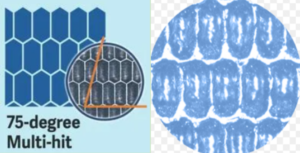
The answer lies in the geometry of the anilox cell. Today, we’ll explore a powerful tool designed for high-definition printing: the 75-degree “Extended Hexagon” cell.
Structural Insight: Elongation, Not Deepening
With conventional 60-degree hexagonal cells, simply deepening the cell to increase ink capacity makes it difficult for the ink at the bottom to be released.
The core principle of the 75-degree extended cell is to elongate the cell along the printing direction. By increasing the surface opening area rather than the depth, the cell’s volume is expanded. Because the cell remains shallow—and features a flat bottom—ink is released exceptionally smoothly, significantly reducing ink misting.
Why is it the preferred choice for high-precision printing?
- Supports higher line counts:For a given ink capacity, the extended design allows for an increase in the anilox roller’s line count by approximately 30%–40%. This enables the use of finer rollers, which enhances the clarity of halftone dots, fine text, and the edges of solid areas.
- Resists clogging and is easy to clean:The open, elongated structure prevents ink from stagnating, keeping the cells clean for longer periods and reducing downtime caused by clogging.
- Ideal for mixed layouts (solids and halftones):When a single plate contains both solid areas and fine screen patterns, this cell geometry provides sufficient ink coverage while perfectly reproducing intricate graphic details.
An Objective Perspective: Drawbacks and Limitations
No cell geometry is perfect. As noted by HERZPACK, the expansion of the cell opening results in thinner cell walls. This places extremely high demands on the precision of the laser-engraving process; if the manufacturing quality is insufficient, it may compromise the roller’s wear resistance and its ability to provide adequate support for the doctor blade.
Therefore, it is essential to choose a supplier like us—one that employs high-precision laser engraving technology—to ensure the integrity of the cell shapes.