In the printing industry—particularly in flexographic printing (also known as flexo or gravure printing)—the “60-degree unit” refers to a structure on an Anilox Roller in which the printing cells are tightly arranged in a honeycomb pattern (hexagonal arrangement) at a 60-degree angle.
This is the most standard and commonly used screen roller specification in the printing industry. Below, we break down the specific meaning of this term in printing applications:
- What is a Cell (Network Cell)?
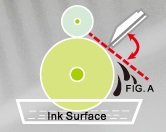
On a printing press, the screen roller is the core component responsible for precisely transferring and controlling the amount of ink. The surface of the screen roller is composed of countless microscopic pits that are virtually invisible to the naked eye; these ink-absorbing pits are referred to in English as “Cells” (or “screen cells”).
This section contains a detailed explanation of the topic; as a result, it generates a comprehensive display panel.
- What is a 60-degree (dot arrangement angle)?
The 60-degree angle refers to the angle between the arrangement direction of the mesh patterns and the direction of the mesh roller.
Honeycomb arrangement (hexagonal): When a 60-degree angle is used, the mesh cells naturally form a regular hexagonal structure resembling a bee hive.
Is it 60 degrees? In geometry, the regular hexagon represents the arrangement with the highest spatial efficiency. Compared to the traditional 45-degree diamond-shaped arrangement, the 60-degree arrangement allows the “walls” separating the mesh holes to be significantly thinner.
- Advantages of the “60° Cell” in printing
Higher ink storage and transfer capacity: For the same area and number of lines, a 60-degree honeycomb pattern can support approximately 15% more mesh cells than a 45-degree pattern, offering greater ink storage capacity and more uniform, stable ink transfer.
Preventing printing: During multicolor offset printing, if the dot angle of the printing plate overlaps with the angle of the screen mesh roller, an unsightly pattern will appear. A 60° angle is considered the “golden angle” – the angle most likely to conflict with the dot angles of flexographic printing plates (e.g., 15°,45°, or 75°) when calculated.
Protective ink scraper: The 60°-angled arrangement ensures uniform force distribution, effectively reducing wear on both the ink scraper and the screen roller surface, thereby extending the service life of the components.