In flexographic printing, the anilox roller is often called the
“heart” of the printing press. The geometric shape of its cells directly
determines ink transfer volume, ink release, and, ultimately, print
quality. Frequently, persistent issues on the press floor—such as ink
misting, “ghosting”, insufficient density, or premature drying on the
plate—do not stem from machine calibration errors, but rather from
an incorrect choice of cell structure at the very beginning.
How should one correctly select anilox cell structures? It
requires a deep understanding of the various types, their functions,
and their core advantages. As a professional provider of rollers and
cleaning equipment, our technical team offers this in-depth industry
analysis:
60° Hexagonal Cells: The“All-Rounder”of the Flexo World
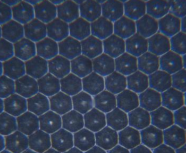
This is currently the most widely used cell structure, accounting
for 90% of all flexographic printing applications.• Structural Advantages: These cells feature thinner cell walls and a
larger opening area, resulting in superior ink release.
- Ink Transfer Characteristics: With fewer intersections between cell
walls, this design minimizes doctor blade wear and reduces “dead
zones” where ink might stagnate, ensuring uniform and stable ink
transfer. It serves as the standard choice for the vast majority of
routine flexographic printing tasks.
60° Open-Channel (Connected) Cells: The Solution for UV
Inks and Ghosting
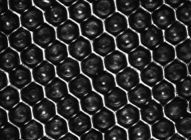
Building upon the standard 60° hexagonal design, engineers
have introduced a “connected” (open-channel) configuration.
- Structural Advantages: While retaining the hexagonal structure’s
ability to support fine screen dots, this design incorporates channels
that significantly enhance ink flow.
- Application Scenarios: Specifically engineered to address the
challenges of transferring high-viscosity inks. If you encounter
issues such as UV ink misting, ghosting, low density, or ink drying
on the plate, this open-channel design allows viscous inks or
coatings to flow between cells—replenishing the supply anddramatically improving ink release and transfer efficiency.
Quadrilateral Cells: The Preferred Choice for Metal Gluing
Rollers
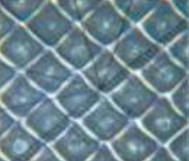
- Structural Advantages: Offers excellent ink/adhesive release and a
broad range of applications.
- Use Cases: Typically found on metal anilox rollers, these are
primarily used for applying adhesives (e.g., gluing rollers for
corrugated cardboard boxes). They are relatively rare on high-end
ceramic rollers.
Diagonal (Spiral/Tri-helical) Cells: The Solution for
High-Viscosity Coatings
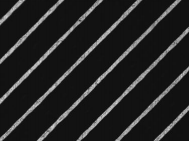
- Structural Characteristics: Cells are arranged in a spiral pattern,
forming an open (non-enclosed) structure (common angles include
45°, 60°, and 65°).
- Use Cases: Not a mainstream choice for high-precisionflexographic printing; rather, it is specifically engineered to address
fluid-flow challenges under certain operating conditions. It
significantly facilitates the flow and transfer of high-viscosity inks
or coatings, making it ideal for applications such as varnishing,
coating, or applying lacquers.
ART (Anilox Reverse Technologies) Cells: The Champion of
Heavy-Duty, High-Volume Coating
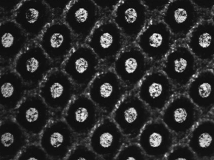
ART cells transcend the limitations of conventional geometric
shapes. Their core feature is a unique open structure: the cells are
interconnected, while raised “pillars” remain to support the doctor
blade.
- Structural Advantages: The open architecture allows for an
exceptionally large cell volume (ultra-high ink/coating capacity).
- Use Cases: Specifically designed for thick-film coatings or
high-viscosity materials. Primarily used for applying varnishes (in
offset printing) or heavy-bodied inks (in metal printing), ensuring
stable transfer even when extreme ink-carrying capacity is required.75°
75° Elongated Cells: The Top Choice for High-Precision
Label and Packaging Printing
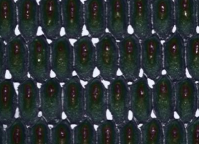
This is a geometric engraving pattern for ceramic anilox rollers,
purpose-built for high-precision printing and stable ink transfer.
- Structural Advantages: By modifying the traditional hexagonal
cell—elongating it along a specific axis and adjusting its angle—this
design achieves an optimal balance between ink-carrying capacity,
release performance, and the structural support provided by the cell
walls.
- Application: Ideal for printing fine text, halftone images, and labels
or packaging that require high-definition reproduction.
75° Channel-Connected Cells: The ultimate solution for
narrow-web labeling and UV printing
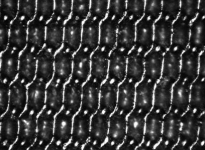
- Structural Advantages: Building upon the 75° elongated cell design,
this configuration incorporates interconnected channels (linked cells).This structure maintains a high ink-carrying capacity while
effectively preventing “ink spitting”—a phenomenon caused by ink
accumulation under the pressure of the doctor blade.
- Application: Commonly used in narrow-web labeling and UV-ink
printing; the premier choice when high precision and superior ink
flow are required.
So, how can you ensure your anilox rollers remain in
optimal condition?
Selecting the right cell geometry is only the first step toward
resolving ink transfer issues. Whether you use standard hexagonal
cells, precision ART cells, or 75° elongated cells, inadequate daily
cleaning and maintenance can lead to dried ink clogging the cells.
This results in insufficient ink transfer, causing uneven ink laydown
or “starving” (where the substrate shows through).
The key to consistent print quality lies in a combination of the right
cell configuration and professional deep-cleaning methods (such as
ultrasonic cleaning).
If you have any questions regarding cell geometry selection or
troubleshooting ink transfer issues, please feel free to contact our
technical team. We offer customized roller engraving solutions and
high-efficiency cleaning equipment to help you overcome any
printing challenges.