In the printing industry, the screen roller (screen roller/screen wheel) is often referred to as the “heart” of a printing press. It is a roller with a surface that has been precision-machined; its primary function is to deliver heat to the printing plate with precision, uniformity, and consistency.
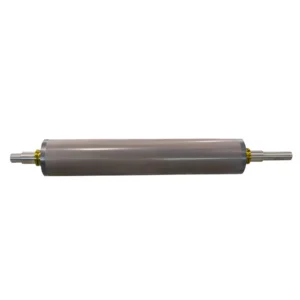
Whether you are using a traditional solid mesh roller or a lightweight mesh roller, the role they play and the physical principles governing their operation during the printing process are exactly the same.
- The operating principle of the mesh roller (Three-Step Ink Transfer Process)
In flexographic printing (Flexo), the screen roller acts like an ultra-precise “measurement spoon”:
Inking: The screen roller is immersed in the ink tank, or ink is supplied directly from the closed Chamber Doctor Blade, ensuring that the numerous surface cells (screen cells) are filled with ink.
Ink scraping: The Doctor Blade makes close contact with the surface of the screen roller to remove excess excess ink from the surface, leaving only the ink within the screen cells. Subsequently, the cell volume (screen cell volume) determines the ink capacity of this cylinder roller.
Transfer: The screen roller comes into contact with the printing plate cylinder, transferring the ink from the screen grooves onto the dots or text on the printing plate.
- The Evolutionary History of Textured Rollers
The materials used for webbing rollers have undergone two major technological revolutions:
- First generation: Metal mesh roller (chromed steel mesh roller)
Adding an additional conditional code enables the screen printing equipment to directly adjust and increase the printing dose, ultimately generating a comprehensive final output image.
Process flow: A mesh pattern is created on the surface of the steel roller using mechanical rolling (texturing), followed by a hard chrome plating layer to prevent wear.
Disadvantages: The mesh angle is typically 45 degrees, resulting in poor wear resistance and a low line density (generally below 300 LPI); as a result, this technique has been largely phased out, except in certain applications such as folding or rough printing.
- Second Generation: Laser-Engraved Ceramic Anilox Roll – Modern Standard
Manufacturing process: A highly hard ceramic chromium oxide layer is sprayed onto the surface of the steel shaft or workpiece, followed by the ablation of a mesh pattern using a laser.
Advantage: Capable of creating the aforementioned 60-degree honeycomb-dot patterns with exceptionally high hardness (approaching maximum hardness), achieving dot counts exceeding 1500 LPI and enabling the printing of extremely fine dot patterns.
- Verify the three key performance indicators for a single Anilox Roller
When you receive a specification sheet for a screen printing roller, you will invariably find the following three core parameters – together they determine the printing performance of this roller:
- Network cable count (Anilox Line Screen / LPI or L/cm)
The number of mesh openings arranged per inch (or per centimeter) of length.
When printing high-precision patterns (e.g., four-color halftones at 150 LPI), it is generally necessary to use a screen cylinder with a line density 4–6 times higher (e.g., 700–900 LPI); otherwise, the halftone dots on the printing plate may fall into the screen apertures of the screen cylinder, resulting in a “dirty plate” condition.
- Cell Angle
This refers to the 60-degree angle (the most common honeycomb structure); there are also special variants with 30-degree or 45-degree angles.
- Cell Volume (BCM or cm³/m²)
The ink capacity of the mesh aperture: the larger the volume, the thicker the printed ink layer and the deeper the color.
- The fatal flaw in routine maintenance
Although ceramic mesh rollers are highly wear-resistant, they are quite “brittle”; they are most vulnerable to two specific issues.
 Impact damage: When the ceramic layer comes into contact with metal, chipping is likely to occur. Once the ceramic surface is damaged, the corresponding network pores can no longer function properly for ink storage, leaving permanent streaks or spots on the printed material.
Ink clogging: If the press is not cleaned promptly after shutdown, the ink (especially fast-drying UV ink or water-based ink) will dry out within the deep grooves of the screen mesh at 60°C. Once clogged, the Cell Volume of the screen roller decreases, resulting in faded printing colors. Manufacturers are typically required to use an ultrasonic cleaner or a baking soda/dry ice sandblasting system for regular deep cleaning.