
In a flexographic printing workshop, if you’re unsure which
cell shape to choose, a 60-degree hexagonal pattern is almost always
a safe bet. As the most prevalent and efficient cell structure in the
industry, it accounts for over 90% of the flexographic market. Why
has it become the “go-to” solution? Today, we’ll take a deep dive
into the 60-degree cell, examining its characteristics through the
lenses of geometric structure and ink-transfer mechanics.
Geometric Advantages: Maximizing Space Utilization
The core strength of the 60-degree hexagonal pattern lies in its
exceptional space utilization. For any given surface area, it features
the thinnest cell walls (the partitions between cells) and the largest
opening area. This means that at the same screen count (line count),
it can hold more ink than shapes like the quadrangular pyramid,
resulting in a greater and more uniform ink transfer.
Furthermore, the arrangement of regular hexagons effectively
prevents or mitigates the occurrence of moiré patterns (interference
fringes) during high-speed printing, ensuring high-quality output.
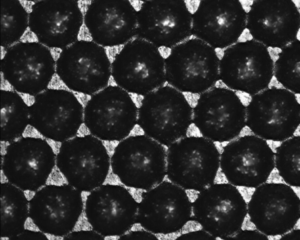
Ink-Transfer Performance: Eliminating “Dead Zones”
Because there are fewer intersections between cell walls, the
60-degree pattern reduces wear on the doctor blade and significantly
minimizes “dead zones” where ink might otherwise get trapped. The
ratio of the opening width to the depth is optimally designed
(approximately 0.28), ensuring smooth ink release. This prevents
issues where ink at the bottom of a cell—if the cell were too deep or
narrow—might fail to transfer or become difficult to clean out.
Versatility: Perfectly Suited for Everything from Cartons to
Labels
Solid areas/coarse lines (low screen count, <300 LPI):
Leverages its high-volume capacity to provide an ample supply
of ink.
Fine dots/text (high screen count, >750 LPI): Can be adapted
into an elongated hexagonal variant, maintaining fine detail andink-carrying capacity without increasing cell depth. (It is
recommended that the anilox screen count be 4–5 times the
screen count of the printing plate; this prevents small highlight
dots from sinking into the cells, which would otherwise lead to
excessive dot gain.)
Maintenance Notes: Prevent Impacts and Clean Regularly
The cell walls of the hexagonal honeycomb structure are
extremely thin and have limited physical strength. Take great care to
avoid impacts during handling; any scratches from hard objects will
permanently impair the ink-carrying capacity of the affected area.
More importantly, timely daily cleaning is essential. Dried ink
can easily become trapped within the fine honeycomb cells, causing
clogs. Regular deep cleaning using an ultrasonic cleaner is
recommended to ensure optimal ink release.
Q:What materials are 60-degree cells suitable for?
A:They are highly versatile and suitable for a wide range of
applications, including standard cardboard boxes, flexible packaging,
and labels.
Q:How can I tell if the cells are worn?
A:Check for a decrease in print density, or use a magnifying glass to
see if the cell walls have been worn flat.
Q:What is the typical BCM (ink-carrying capacity)?A:The range is quite broad—from 2.0 BCM for fine-dot printing to
over 15 BCM for solid-area printing—and should be customized
based on specific printing requirements.